Science
Primary Science Quality Mark Evaluation - 2024
In 2024, St Ethelbert's Catholic Primary School and Nursery are taking part in the PSQM evaluation. The purpose of the trial is to study the effectiveness of PSQM in improving primary age pupils’ science attainment and attitudes to science. This is a significant research project involving 340 schools across England that will further our knowledge of improving school-wide science leadership, teaching and learning, and raising the profile of science in primary schools. The evaluation is funded by the Education Endowment Foundation and led by Manchester Metropolitan University, in collaboration with the University of Hertfordshire.
Intent, Implementation and Impact Statement - Science
Intent
At St Ethelbert’s School we recognise and value the importance of science and scientific enquiry and
aim to develop in all young people a lifelong curiosity and interest in the sciences in every aspect of
life. We intend for children to have the opportunity, wherever possible, to learn through varied
systematic investigations, leading to them being equipped for life to ask and answer scientific
questions about the world around them.
Throughout the individual programmes of study, our children will build on their skills in working
scientifically, as well as on their scientific knowledge, as they develop greater independence in
planning and carrying out fair and comparative tests to answer a range of scientific questions.
The desired outcome will be that they can apply their knowledge of science when using equipment,
conducting experiments and investigation, building arguments and explaining concepts confidently,
being familiar with scientific vocabulary and, most importantly, to continue to ask questions and be
curious about their surroundings. They will then be able to use these learnt skills to make many
cross-curricular links, especially in the areas of Maths and Design and Technology.
Implementation
The acquisition of key scientific knowledge is an integral part of our science lessons enabling our
children to learn and retain the important, useful and powerful vocabulary and knowledge contained
within each unit. The progression of skills for working scientifically are developed through the year
groups and scientific enquiry skills are of key importance within lessons and teachers will
demonstrate how to use scientific equipment and the various ‘Working Scientifically Skills’ in order
to embed scientific understanding. The progression of these skills is set out in the Science
Progression Map. Each lesson has a clear focus. Scientific knowledge and enquiry skills are
developed with increasing depth and challenge as children move through the year groups. They
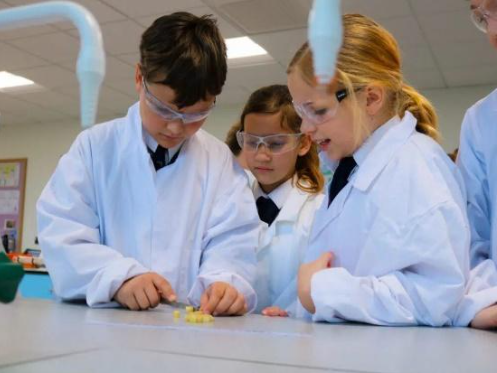
complete investigations and hands-on activities while gaining the scientific knowledge for each unit.
Interwoven into the teaching sequence are key assessment questions, identified in green on lesson
plans. These allow teachers to assess children's levels of understanding at various points in the
lesson. They also enable opportunities to recap concepts where necessary. The sequence of lessons
helps to embed scientific knowledge and skills, with each lesson building on previous learning. There
is also the opportunity to regularly review and evaluate children's understanding. Activities are
effectively differentiated so that all children have an appropriate level of support and challenge. Our
detailed lesson plans include adult guidance to ensure that teachers are equipped with secure
scientific subject knowledge, enabling them to deliver high-quality teaching and learning
opportunities while making them aware of possible scientific misconceptions. We will also focus on
our environment outside of school using the natural resources – parks, wildlife areas and beaches –
to support and reinforce learning. Through enrichment days, such as ‘Science week’, outside visits
and visits from experts we will enhance the learning experience and promote the profile of Science
allowing time for our children to freely explore scientific topics.
Impact
Within science, progress is measured through a child’s ability to know more, remember more and
explain more. Our science curriculum is high quality, well thought out and is planned to demonstrate
progression. The impact of using the full range of resources included in the science unit will also be
seen across the school with an increase in the profile of science. The learning environment across
the school will be more consistent with science technical vocabulary displayed, spoken and used by
all learners.
We will measure the impact of our curriculum through the following methods:
St Ethelbert’s Intent, Implementation and Impact - Science
Assessing children’s understanding of topic linked vocabulary throughout each unit
Children complete cold and hot mind maps
Marking of written work in books to coincide with summative assessment of pupil
discussions about their learning.
Images and videos of the children’s practical learning.
Interviewing the pupils about their learning (pupil voice)
Teacher assessment of their pupils at the end of every unit
Moderation staff meetings where pupil’s books are scrutinised and there is the opportunity
for a dialogue between teachers to understand their class’s work
Formal reporting of standards at the end of each Key Stage and annual reporting of
standards across the curriculum to parents
Whole-school and parental engagement will be improved through the use of science-specific home
learning tasks. Children who feel confident in their science knowledge and enquiry skills will be
excited about science, show that they are actively curious to learn more and will see the relevance of
what they learn in science lessons to real-life situations and also the importance of science in the
real world.